

Of conductors and orchestras
Let's imagine that the phonological system of a certain language is the brass section of our metaphorical orchestra. The morphology might be represented by the woodwinds. The strings might be the syntax, and the percussion section could be the semantics. And together they play a certain piece of music (the communication) based on a certain musical score.
Now a different orchestra, representing a different language, might do things quite a bit differently while still trying to play the same music (notes, melody, etc.). Here perhaps I should really talk about arrangement and arrangers rather than conducting and conductors. What the “brass section” did in the first language might be done by the “woodwinds” in the second. And so on.
Examples are in order. We all know that semantic networks between languages do not match up, and that therefore we have to posit (unless we really think there are "better" and "worse" languages) that the world is somehow adequately divided up in all the different languages of the world, albeit somewhat differently in each.
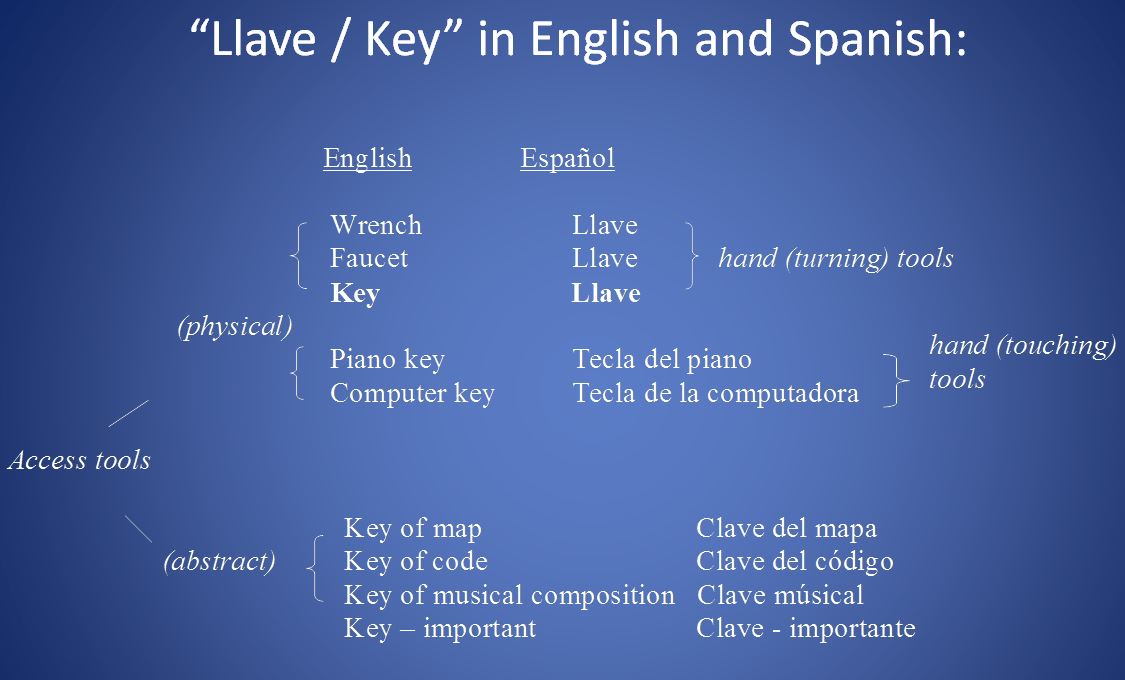
Here there is a nice example between English and Spanish: the word "key" in English is usually (given the default context) translated as "llave" in Spanish. This refers to the object one uses to open a lock of some kind. But "key" can also be translated as "tecla" (piano/computer key), or even "clave" (key to a code or map, or musical key, or problem).
Meanwhile, starting from Spanish and going to English, one can translate "llave" as "key" (to a lock), but also as "valve/faucet/hose bib," or even "wrench," depending on the context.
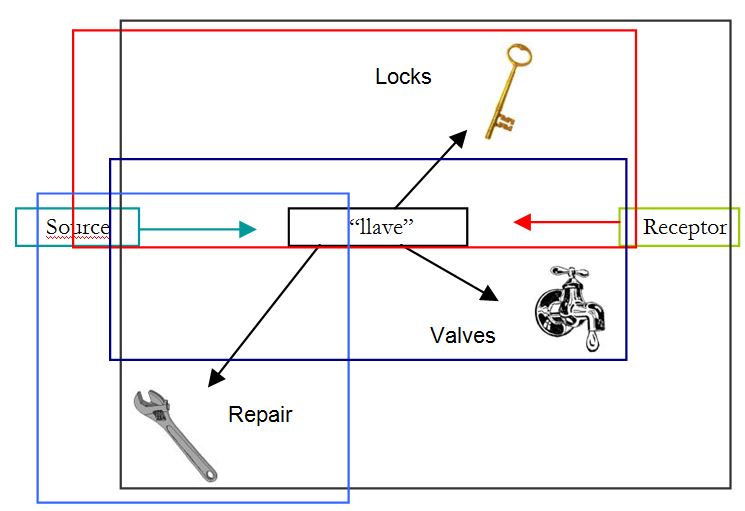
So what is going on? English apparently sees some kind of semantic relation between locks, pianos, computers, and even codes and maps. Spanish sees relations instead between locks, valves, and wrenches. This assumes of course that these examples represent true semantic networks and are not just homonyms. But assuming that for the moment, what are the different semantic relations at work here?
In English, we may think of the concept of ACCESS. In each case (locks, pianos/computers, codes/maps/musical scores/problems), the key is something (usually small literally or figuratively) which gives ACCESS to something "larger."
Meanwhile in Spanish the semantic network for "llave" seems to be more local and physical in nature: a "llave" is a hand-turning tool of some sort, as opposed to a finger-poking gesture (tecla) or a figurative point of entry (more like the English ACCESS perhaps).
The following diagram attempts to capture the semantic relations described above:
But in these cases the "instruments" of the orchestra are the same (the lexicon), and the variation is more in terms of the tone and texture of the music (or communication) itself. A better example perhaps is the following: in English, we an speak of standing "on the corner" or "in the corner," and we know by the different prepositions used that one is referring to the outside edge of a 90 degree angle (a street corner) or within the inside edge of such an angle (corner of a room of a house). Spanish can accomplish the same communicative/semantic effect without recourse to prepositions with "en la esquina" (on the corner) versus "en el rincón" (in the corner). These phrases rely solely on the lexicon for the distinction English makes with "on/in," using the same proposition "en" in each case.
Interestingly, Spanish more commonly does the opposite. Examples abound: "subir" (go up), "bajar" (go down), "entrar" (go in), "salir" (go out), "meter" (put in), "sacar"(take out). One can quibble that in English we can do the same as in Spanish with terms such as "ascend , descend, enter, exit, insert, and extract," but then we are really using Latin-based terms, and we are back to the difference between Anglo-Saxon/Germanic and Romance languages.
My thesis is a broader one than illustrated above: the different elements of all languages, like members of an orchestra, are very flexibly used for similar/same communicative purposes (like conductors, or perhaps better, music arrangers). If this is true, it is a very powerful argument for functional equivalence in translation and against (except in special circumstances) formal translation. And of course there must be a huge number of examples of how language elements are used in the flexible way I describe above.
I would be interested in developing this as well as the other metaphors for language, culture, and translation I have posted to MAP.
As always, comments are welcome.
Attachments
- Capture.JPG47 KB
- Capture.JPG75 KB
2 comments
Sign in to join the conversation.
Seppo, Thank you for trying to make me make myself more clear. I can always count on you for that. Let's imagine that the phonological system of a certain language is the brass section of our metaphorical orchestra. The morphology might be represented by the woodwinds. The strings might be the syntax, and the percussion section could be the semantics. And together they play a certain piece of music (the communication) based on a certain musical score. Now a different orchestra, representing a different language, might do things quite a bit differently while still trying to play the same music (notes, melody, etc.). Here perhaps I should really talk about arrangement and arrangers rather than conducting and conductors. What the “brass section” did in the first language might be done by the “woodwinds” in the second. And so on. Or to come back to some examples in my post, what one language does with the lexicon might be accomplished through syntax (using prepositions) in the second. And of course much more drastic changes as well. I may go back and include examples of whole phrases which are surrounded by morphology which looks like it belongs at the word level to us (English speakers). Things like morphology marking person and number. As for functional versus formal translation, I'm thinking that formal translations would always try to use the brass section as much as possible in translation if the brass section were used by the source language. That is presumably why you get such unnatural constructions in formally equivalent translations, as they try to reproduce the grammar and lexical networks of the source text in a language that wants to play the same musical score (notes, etc. = meaning, or communicative purpose if you prefer), but using different instruments (or language elements). Thus the metaphor would not be of playing a different kind of music, but of trying to play the same music either with the same instruments as the original (formal), or with instruments contextualized for the new situation (functional). The metaphor will break down for audiophiles who may insist that it is no longer the same musical score when different instruments are doing the playing. Fair enough. Metaphors have their limits. I probably could have made myself more clear in my post and included this explanation that I've given here in the post itself. Perhaps I'll go back and do that.
I have been thinking of the music metaphor in application to the Score to be performed [the Source Text and its meaning] and the Performance [the orchestra's & conductor's meaning of the score for an audience]. A translation is a performance of a score -- Vivaldi's Spring, let's say -- by a different orchestra and conductor and for a different audience. The Score is an annotated manuscript, and the Performance is something else, an aural experience, for one. At this level the metaphor doesn't deal with the individual 'notes' or lexemes etc in different languages, but with the interpretation of a manuscript into making music, with different 'interpretations' of the manuscript being possible.