

Drafting Translations by Adaptation
Many of the remaining Bible translations needed in the world are in languages related to completed New Testaments or Bibles. One leveraging point that can help us accelerate the translation process is by using adaptations instead of starting from scratch each time.
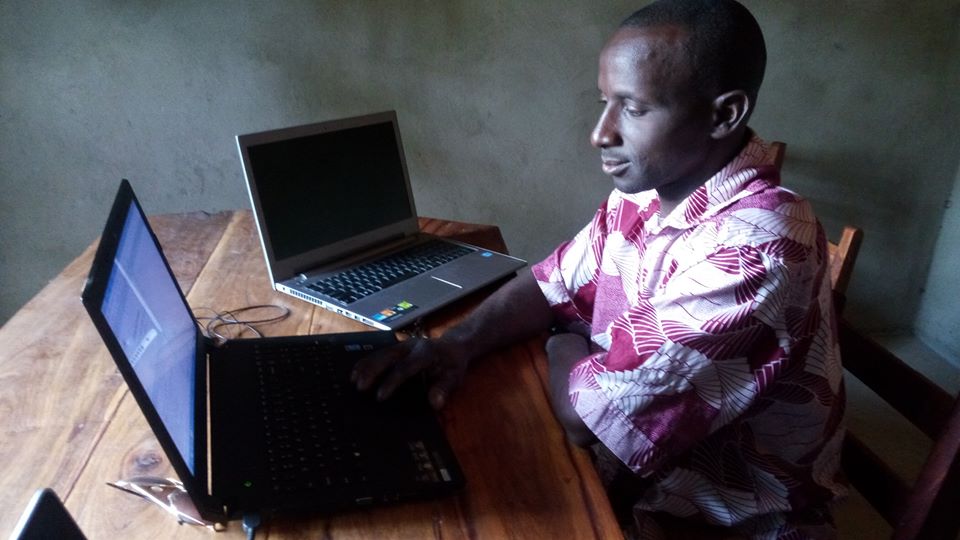
In this video I describe how we are adapting from Yalunka to Sankaran. The Yalunka language has a whole Bible. The languages are about 28% shared vocabulary. The word order between the languages is very similar. The local translator who used ParaTExt to complete the Yalunka project is now helping the Sankaran translators learn how to use ParaTExt to adapt the Yalunka Bible to Sankaran. (see thumbnail photo)
It would be beneficial if each new translation project starting in the world today envisioned ways to leverage the existing nearby related translations. The approach leads to better quality translation by starting with a draft from someone else's finished product. It accelerates the translation. It is less expensive especially if run by local people. The method can be one of the rare ways to do Bible translation better, faster, and cheaper.
In the world today there are many Bible translation projects that are run by highly trained local people that are finishing their own project. Rather than sending them back to some other career, these local translators who are experienced in using ParaTExt could assist nearby new translation projects to achieve an adaptation like this one. The adaptation serves as a high quality draft that can then go through the normal process of refinement.
Adaptations can accelerate getting the whole Bible into entire language families. For example, in this case, after the Sankaran translation of the Old Testament is complete, this same method can possibly leverage that work into four other languages that are more than 80% shared vocabulary with Sankaran. One Bible can efficiently become five by strategic, carefully reviewed adaptations.
Extracted text from Drafting_by_Adaptation.mp4:
It can be an advantageous way to draft scripture to use a computer program like text to generate a rough draft by an adaptation from one language to another . In this case we have an entire bible in the Yalom language here and we have a group that's trying to generate a Bible in the sun cut on language here . And the idea is to use the interlinear Isar feature of pre-text to translate from a draft from Ya'alon GA to Sankaran . So here's how you get started doing that . You come to the file and you say Open Project interlinear Isar . And you specify that the text interlinear Isiah's Ya'alon Ga . And then the that's the source text and then you have the you specify the resect or text here and you go to the Advanced tab and you click on that . The fact that the model in the project languages are related . And you also tell it that you're going to automatically export versus when approved to the song . Translation you say OK . And in this case the two texts are using different versification . But we're going to go ahead and say yes and then it begins to to make all kinds of mathematical calculations it's comparing mathematically the texts of for example Genesis Exodus Genesis and Exodus and John and several other parts of the Bible that have been done in Sankaran to the parts that those same parts and yet don't call . It takes a little while for it to load . It takes a little while to do apparently an inestimable amount of calculations going on here . And then it appears . OK so let's go ahead and try to look at what it would be like to do a draft of a verse of Scripture so we have the translator who completed the project is well versed in how to use computers because he just finished an entire Bible translation projects we're talking about the local man named Don SA . And then we have another man who's a native speaker of the Sankara language the language that they have in common is the money in language . And so this the Yalom speaker can talk to Ebrahimi the Sankaran speaker in mining and they can negotiate the adaptation themselves once they are once they're trained in how to do it . So here's how the adaptation works . Anybody with some knowledge of the related languages can work on this but it's best if you've got two native speakers of these languages sitting there and can actually generate more definitive results . So this you can look over here to see what we're translating the sons of Haleigh . So we have Haleigh CA at and I looked looked this up and it's actually not spelled that way in in song . It's spelled like that . So you tell it . And you get the equivalency . And here is me and we know this from other work that we've already done . So hot on it actually happens to be in its analysis it has some suggestions for us . So Socotra has a link as a name of a person and it turns out that this always gives you the same thing again here in the first position . Then it gives you suggestions and usually the second one is the actual one that's that's that it's calculated from other places where that word occurs . Same kind of situation here but this name never occurs in in the Bible until this moment . So here at least and what's already been translated so that's the same . So then you say approve and export to Sankara . You click on that and you'll notice that that part of the verse that verse appears up there . And then you come to the next one . It's just kind of a continuation . Noone is right . OK now look here this . This is interpreting this to mean that there is a suffix there . In actual fact it's just the names you click and it now knows that's not a suffix . And I've already looked and Kosi would be fitting to just be Kosi and then body is so wrong . Yea is ha . And so here we have linked . Aha . So that it can recognize it as you . And it just automatically knows that now Kosi car . In this case cause appropriate I believe a newbie thinks that that's a suffix but now it knows better . It's giving me an interesting proposal but actually a newb is probably a good way to put that if somehow the Monica translators don't like that they can just change it me . Here again we have so are . Probably inappropriate . I looked it up it's doesn't occur elsewhere . So that would work just fine . Sauron is strong and noom is linked together and it is on the Harumi . Once again you could probably just go ahead and keep that . And then we have HANO How to me in this case this is the possessive and they don't do possession in the same way in the Sankaran we've learned . And so this is Dane K so this D is doing normally but since this is a masculine person Sonke requires that we go ahead and specify masculine which is what that is . And then again we all make that not be parsed . And here's an example where . They don't have axes . So we'll put H's there . And that should give them a leg up on that . And then Habila me is Kublai Lu . We've already figured that out from previous times . So of course this is a rough draft that will have to be verified by a native speaker and I'm just showing how this works . But here's your base . That one's already been built become learned somehow . I may say Binyon support base a really strong tomming which is dung which means surpassing and not kill annoying to . And I believe this is the expression for timing is lie . So let's look for that law . I believe that's right . Yeah that should be right . So that expression I looked it up in other places and they use Dunga who is timing a lot . OK so you say not talk a lot . So here's an expression that is really means to name somebody and to really connect that just so you can see how to how to work that out . And it is actually oh it has the suggestion of a law that has done that mathematically somehow knows that it's totally OK so that's working . And then this usually does not correlate to anything in Sankaran that we can figure out yet . Those are correct . Cool . That's your quote marker and you have whenever this raw is in the presence of the nasal here you have to select da . So that's a phonological function that it does not take into account . Da la WA total roll . So I looked that up and toldo is total and Torrone typically in the text . Correlate corresponds to Corduroy Ja Rule K. . So I looked that up in other places and typically that's what you get . So one benefit you get when you're doing an adaptation is it's already got footnotes in it . So so the footnote says you are based on my own cang which is the equivalent of Weena do . And they say that's the equivalent I mean some and then in this case I think is LA . And that'll have to be checked by a native speaker of course and just sort of showing how this would work in practice habitues probably wouldn't in this case I don't see any other options popping up con or all means in the language of . And I'll take a split of that . OK so that's wienie it knows that he is calling and me tends to be a role and then it proposes CON-TROLL and that will need to be verified . This is accurate and then I've got a big long phrase linked together and as equivalent to this . And then I did look up whole and I did some research on it and it does appear to be Kuna . So now we have a an attempt at that we can say a proven expert . Now somebody will have to go through here and look at all of that to make sure it's accurate . Gabay Sakae is that I only allow my thought . And so Jabez prayed to the God of Israel and this we can insert . See this is Eastleigh a lot a . There needs to be a possessor there and that is a possessor . So let's add a parsing here and you can say no that is a suffix and I have a little problem with my keyboard . That is a suffix right there . Now it says OK that's law typically . And so what we can do is we can say let's just Abdulai here and between these two words and you have Sri yellowy la la Matata . So now it's possessive properly and that is actually accurate . So then this is the quote mark . Let's see what this one is . OK it is actually Jonti so it proposes that based on calculating it and it is accurate . I don't know why it thinks that's Yundi let me see quickly . Oh I see . Should not be parsed and now I knows that that's John de Barakaat . So I didn't I looked looked up all the cases of maracanã which means blessed me and they do not say Baraka that way typically they have this entire phrase . And so what I'm going to do is I'm going to link and Barakaat and I'm going to say that should be bought a car but a car don't . Nah . Q Karl All right I've got not Korol . That's an entire phrase that corresponds to Barakaat and I figured that out by doing a search and figuring out that whenever we hadn't bought a car in one language it correlated with this entire phrase car . This is an example of of a discourse difference there . And so we have Barkat not Coro car now do . So this is my earth . Add to it . And so this is an expression that means add to . And I researched that one earlier and it typically would correlate to Mont Cafu which we have the same verb in Ya'alon car and that would be that would be the equivalence of that the fun car . Loophole . So your strength . So this one would need to have a processor in Sankaran the foreign car ye that's the appropriate correspondence there . Lou is to say I think that is correct . Me you know . OK so this one not tongue . I looked it up . And typically that is LA and this one is tongue called . So the two of them actually do work together and it is lot tongkat . And so we have Toro MA Of course . Coo coo now khana and so on . So all of that seems to work . Le Carre Dubois do probably dwil would be appropriate there or Dubois either way to do . Those are actually synonymous . Jobby is what the J in this language jobby because now you can see another verse there . And of course that will have to be verified . And you can see it appearing up here . So we have several advantages in doing this kind of methodology . The person who has already finished a translation over here will know a great deal of computer skills and they might have a lot of exegetical skills so that they can help a new language group begin to learn those same skills . And then you when you're reviewing it you can sometimes improve the source translation . The new translation starts with the finished product of the previous translation . So instead of just starting from scratch we and we start with a draft that is based on the finished product of the other language . So it's a much more refined draft . It's achieved much more rapidly . And so this can give us an acceleration in the translation that is not only an acceleration but an improvement in the quality and not sacrificing of quality to get the acceleration . These two languages are only 30 percent shared vocabulary and if we can make an adaptation work between these two languages then that significantly expands the scope that might be possible to do an adaptation . And there may be many languages that are have a sufficient degree of the same order in their grammar but a lot of words that are different like 30 percent shared vocabulary but because the order is the same then we're able to do a pretty easy adaptation . And the tools that we have now are visual enough to be able to allow local people to master the tools quickly more quickly and then to be able to do an effective adaptation .
0 comments
Sign in to join the conversation.