

Intertextuality (and Scripture Engagement) in Art
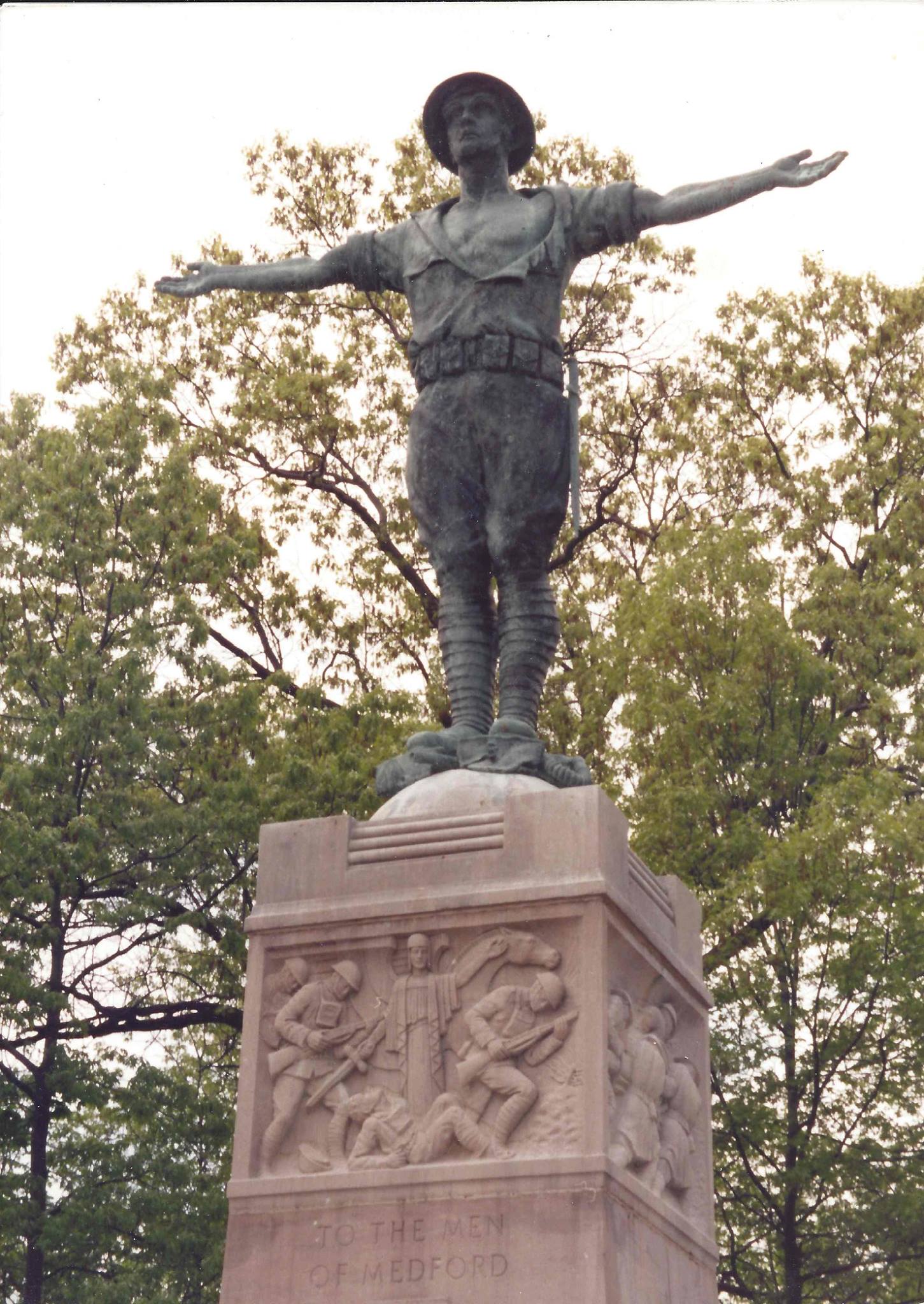
In thinking about Scripture Engagement and intertextuality I find what I consider an interesting example in a large World War I memorial statue that was executed by my grandfather, Emilius Ciampa. This WWI memorial statue, called "The Supreme Sacrifice," is in the Oak Grove Cemetary in Medford, Massachusetts (USA). It depicts an American doughboy with his arms extended in a way that clearly alludes to Christ's own sacrifice on the cross, merging the narrative of American losses in WWI with the narrative of Christ and his crucifixion (and reminding some observers of Christ's statement in John 15:13 ("No one has greater love than this, to lay down one’s life for one’s friends"; NRSV). The soldier is not carrying any weapons in his hands, which was very unsual for war memorials of the time (and it created controversy when my grandfather proposed this for the memorial). [More below the image]
Although it cannot be made out in most pictures of the statue, the soldier is also standing on weapons (and a gas mask). It occurs to me that this may also allude to the common image of the Virgin Mary with her foot crushing a serpent, bringing in a second layer of intertextuality.
I don't offer this as an endorsement of this mixture of Christianity with American civil religion but as an interesting example of intertextuality in art, including the mixture of biblical, Christian and American narratives (and I suppose an example of a kind of Scripture Engagement, right or wrong).
More about the statue may be read on Page 5 of this issue of the Medford Historical Society Newsletter.
Attachments
- Supreme_Sacrifice.jpg393 KB
0 comments
Sign in to join the conversation.