

How Ten Prisoners Translated "The Hobbit" to Hebrew, while in Captivity
Extracted text from http://blog.nli.org.il:
Close the accessibility toolbarX General
visibility_off Disable flashes Fonts Color Contrast
brightness_high Bright contrast Links
format_underlined Underline links
Translating the Hobbit in Captivity Land of Israel In 1970 ten Israeli prisoners in Egypt, captives of the War of Attrition, used their abundant free time for an unusual project: translating J.R.R. Tolkiens first book into Hebrew
Chen Malul | 22.01.18 |
In a hole in the ground there lived a hobbit. Not a nasty, dirty, wet hole, filled with the ends of worms and an oozy smell, nor yet a dry, bare, sandy hole with nothing in it to sit down on or to eat: it was a hobbit-hole, and that means comfort.
(The opening words of the book The Hobbit)
Anyone who knows anything about Tolkien and his battle-riddled stories; the vast, fictitious history and captivating action his books are famous for; will almost certainly have started with the first adventure book the English linguist and author wrote, The Hobbit: Or There and Back Again. That book is certainly not lacking battles and adventures, but in contrast with the Lord of Rings trilogy, The Hobbit is also a sweet and enjoyable childrens book.
It is a book that can bring pleasure and hold the attention of its readers (and its translators) at their darkest hours.
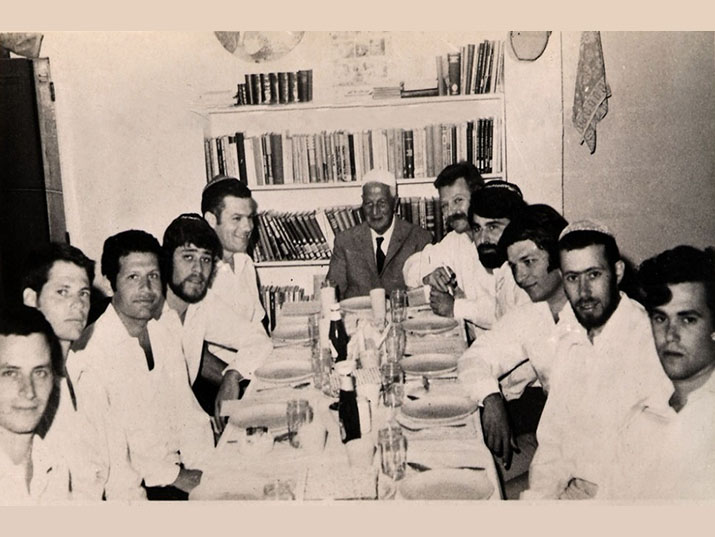
This is not the story of how the book was written, but the story of one of its translations into Hebrew. It is the story of the special edition translated by air force pilots and their comrades in Egyptian captivity in the Abassiyah prison, Cairo (1970-1973), who were captured during the War of Attrition.
The story of a strange and adorable creature
Despite the terrible state of the ten prisoners who were crammed into one cell in the Abassiyah jail in Egypt, after undergoing (and who were yet to undergo) many interrogations and tortures had a positive side, a small flickering light at the end of the tunnel. Firstly, after several months in separate cells far away from each other, the prisoners were allowed to crash in one cell and be comforted from other Israelis in the same state. Secondly, the fact that not all the prisoners spoke sufficiently fluent English proved to be significant to the rest of their stay in captivity.
Not all the cells inhabitants could enjoy the gift which Yitzchak Fir, one of the four pilots in captivity, received from his brother in America. This was a soft back book with the story of a strange and adorable peace loving creature looking for a good and comfortable life who encounters hair raising adventures in the war for a more peaceful and green life (from the foreword of the book).
The four pilots in the cell Avinoam Kaldes, Rami Harafez, Menachem Eini and Yitzchak Fir decided to translate the Hobbit for those who would find it hard to understand. The pilots initially translated specific words and expressions. It did not take them long to discover that the work distracted them from their life in captivity, and soon they found themselves working day after day, for many long hours, on translating the entire book.
The work was done in pairs one reading the text in English and translating it to Hebrew on the spot. The seconds job was to be an editor, to improve the Hebrew translation and adjust it to the high level of Tolkiens original work. The many poems in the book presented a complex challenge, and the four turned to their cellmates for help. They later related that we failed slightly with the poems in the book. Under the circumstances the unprofessional translators found themselves, a labor of love would suffice. The entire project took four months and its unlikely they thought the translation they worked so hard on while in captivity would ever be read outside the walls of their cramped cell.
Hobbit, the translation of the pilots and their fellow captives. It is interesting that the word The has been deleted from the books title, as well as the subtitle Or There and Back Again. Click here to see the item in the Librarys catalog. They were only released from captivity after the Yom Kippur War, bearing a well-used copy of The Hobbit, along with seven full notebooks. In 1977, the Hebrew translation done by the pilots and their cellmates was published by Zmora Bitan Publishers, funded by the Airforce.
Here, Ive arrived Rami Harpaz said when meeting his twin girls for the first time. The first words of the Israeli POWs upon their return to Israel. From an article in Maariv, November 18th, 1973 (Hebrew). There are currently three Hebrew translations of The Hobbit. A year before the translation of the pilots and their fellow captives was published, Zmora Bitan Modan published Moshe Hanamis translation. Another translation, by Yael Achmon, was also published by Zmora Bitan Publishers in preparation for the release of the first part of The Hobbit trilogy directed by Peter Jackson. The translation of the pilots and their comrades is considered the lowest quality translation of the three, but its the translation I grew up on, and as such will always have a warm place in my heart and my years as a hormonal bespectacled, fantasy-loving adolescent.
Below is footage of the Israeli POWs return to Israel from Egypt on November 16th, 1973.
.
Professor Amiah Leiblich documented the story of the capture and lives of the ten Israeli captives in Egypt in the book Chutz Mitziporim [Only Birds] which was published by Schocken Books in 1989.
Chen Malul
Have you reached the library and looking for Chen Malul? No worries, see that teetering mountain of books that's about to collapse? Chen is right behind it. Hobbies: Reading about history, writing about history, talking about history. More articles by Chen Malul >> Get our stories directly to your inbox
All rights reserved The National Library of Israel 2017
Attachments
- 715-537-2.jpg76 KB
0 comments
Sign in to join the conversation.