

Fragmented identities
Part of series Our Multiple Selves
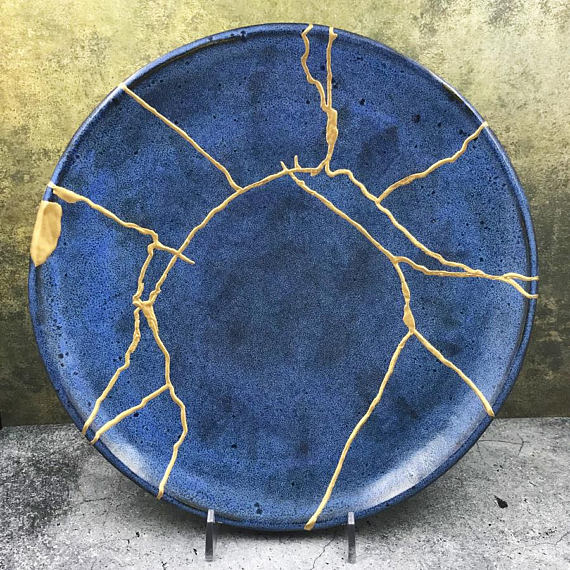
Recently, at the annual UBS Global Bible Translation meeting, our colleague Simon Wong gave a moving devotional in which he used the Japanese art of kintzugi as a metaphor for how brokenness can be made beautifully whole, but with the broken pieces now highlighted by mending the broken vessel (usually a bowl or plate) by a precious metal like silver or gold. Very expensive pottery is often broken on purpose for use by kintzugi artists. Here is a sample:
And here is a link for further reference:
_______________________________________________________
Later, for the final evening of the Global Bible Translation meeting, we had a cultural/fun night. There I presented some slides and a video of where I grew up in Mexico (video below):
As I prepared for my contribution for the evening, I reflected on Simon's devotional. I thought I might use the kintzugi metaphor for how I felt about my own cross-cultural identity/identities: diverse, fragmented, disjointed, yet somehow whole and complete at the same time. But as I thought about it more, I found what I think is an even more apt metaphor for fragmented identity in another fascinating and beautiful art form: the mosaics of Antoni Gaudí. Gaudí is worth spending some time with, and a Google search will yield many hours of pleasure, only to be surpassed by an extended visit to Barcelona to see Gaudí's work (mostly buildings) in person.
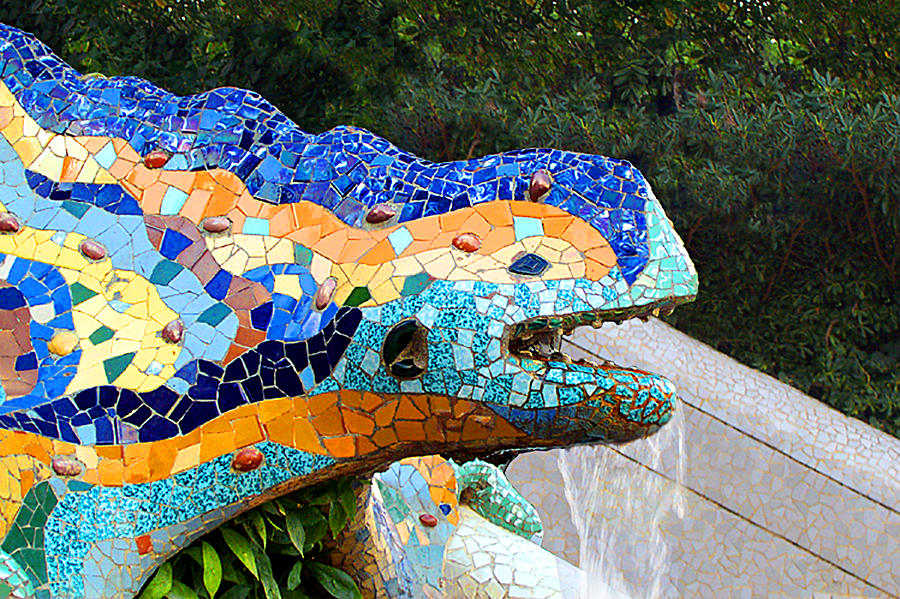
But one image in particular seemed seemed to me to best represent the idea of fragmented identities. There is a small park that Gaudí constructed in Barcelona, with houses and sculptures and walkways and railings and more-all made from (or adorned with) broken pieces of tile. These pieces (unlike the kintzugi art above) had been discarded from actual broken plates, bowls, and other porcelain objects which were now in a trash heap of bits of broken pottery. From there Gaudí took them and (like a mason using a rock quarry) made them into art, the likes of which the creators of the original objects had never imagined. Here is one that is especially representative of his method of recycling bits and pieces of broken tile to make something new and unexpected:
To return to the analogy with cultural identities: I sometimes joke that my stomach is Mexican but my patience is North American (U.S.). I feel like the lizard above-made up of all sorts of mismatched bits of this and that which were never meant to be together. But somehow still whole and complete. And not always nor altogether unhappy with the result.
I suspect many people reading this post will have felt something similar. Here's to recycling!
________________________________________
Note: one could add at least two more sections to this post:
1. Fragmented identities in the Bible (e.g. was Abraham Chaldean, Aramean, Canaanite, Egyptian, Hebrew, or a mix of all of them?)
2. Fragmented identities and BT (can we do BT without fragmenting our identities?)
But I will leave these to the comment thread for the time being.
Extracted text from https://en.wikipedia.org:
Kintsugi From Wikipedia, the free encyclopedia This article is about the Japanese art form. For the Death Cab for Cutie album, see Kintsugi (album).
Mishima ware hakeme type tea bowl, with gold lacquer kintsugi repair work (right), 16th century
Small repair (top) Nabeshima ware dish with hollyhock design, overglaze enamel, 18th century, Edo period Kintsugi (, , "golden joinery"), also known as Kintsukuroi (, , "golden repair"),[1] is the Japanese art of repairing broken pottery with lacquer dusted or mixed with powdered gold, silver, or platinum, a method similar to the maki-e technique.[2][3][4] As a philosophy, it treats breakage and repair as part of the history of an object, rather than something to disguise.[5]
Contents 1 Origin 2 Philosophy 3 Types of joinery 4 Related techniques 5 Influence on modern art 6 Effects on tourism 7 See also 8 References 9 Further reading 10 External links Origin[edit] Lacquerware is a longstanding tradition in Japan,[6][7] and at some point kintsugi may have been combined with maki-e as a replacement for other ceramic repair techniques. One theory is that kintsugi may have originated when Japanese shgun Ashikaga Yoshimasa sent a damaged Chinese tea bowl back to China for repairs in the late 15th century.[8] When it was returned, repaired with ugly metal staples, it may have prompted Japanese craftsmen to look for a more aesthetic means of repair. Collectors became so enamored with the new art that some were accused of deliberately smashing valuable pottery so it could be repaired with the gold seams of kintsugi.[2] Kintsugi became closely associated with ceramic vessels used for chanoyu (Japanese tea ceremony).[3] While the process is associated with Japanese craftsmen, the technique was also applied to ceramic pieces of other origins including China, Vietnam, and Korea.[9]
Philosophy[edit] As a philosophy, kintsugi can be seen to have similarities to the Japanese philosophy of wabi-sabi, an embracing of the flawed or imperfect.[10][11] Japanese aesthetics values marks of wear by the use of an object. This can be seen as a rationale for keeping an object around even after it has broken and as a justification of kintsugi itself, highlighting the cracks and repairs as simply an event in the life of an object rather than allowing its service to end at the time of its damage or breakage.[12]
Kintsugi can relate to the Japanese philosophy of "no mind" ( mushin), which encompasses the concepts of non-attachment, acceptance of change and fate as aspects of human life.[13]
Not only is there no attempt to hide the damage, but the repair is literally illuminated... a kind of physical expression of the spirit of mushin....Mushin is often literally translated as "no mind," but carries connotations of fully existing within the moment, of non-attachment, of equanimity amid changing conditions. ...The vicissitudes of existence over time, to which all humans are susceptible, could not be clearer than in the breaks, the knocks, and the shattering to which ceramic ware too is subject. This poignancy or aesthetic of existence has been known in Japan as mono no aware, a compassionate sensitivity, or perhaps identification with, [things] outside oneself.
Christy Bartlett, Flickwerk: The Aesthetics of Mended Japanese Ceramics Types of joinery[edit] There are a few major styles or types of kintsugi:
Crack (), the use of gold dust and resin or lacquer to attach broken pieces with minimal overlap or fill-in from missing pieces Piece method (), where a replacement ceramic fragment is not available and the entirety of the addition is gold or gold/lacquer compound Joint call (), where a similarly shaped but non-matching fragment is used to replace a missing piece from the original vessel creating a patchwork effect[14] Related techniques[edit]
Nanking reticulated basket, c. 1750, mended with metal staples Staple repair is a similar technique used to repair broken ceramic pieces,[15] where small holes are drilled on either side of a crack and metal staples are bent to hold the pieces together.[16] Staple repair was used in Europe (in ancient Greece, England and Russia among others) and China as a repair technique for particularly valuable pieces.[16]
Influence on modern art[edit] Kintsugi is the general concept of highlighting or emphasizing imperfections, visualizing mends and seams as an additive or an area to celebrate or focus on, rather than absence or missing pieces. Modern artists experiment with the ancient technique as a means of analyzing the idea of loss, synthesis, and improvement through destruction and repair or rebirth.[17]
While originally ignored as a separate art form, kintsugi and related repair methods have been featured at exhibitions at the Freer Gallery at the Smithsonian, the Metropolitan Museum of Art, and the Herbert F. Johnson Museum of Art, Cornell University Ithaca NY, USA.[2][9][11][18]
The concept of kintsugi inspired Tim Baker of the Canadian band Hey Rosetta! in the making of their 2014 album, Second Sight. The lead single, "Kintsukuroi", takes its name directly from the art-form and the cover art of the record features a bowl repaired in the kintsugi method.
Canadian folk band The Rural Alberta Advantage also used kintsugi as inspiration for the art for their tellingly named 2014 record, Mended with Gold.
Death Cab for Cutie named their 2015 release Kintsugi, possibly because during the production of the album, lead guitarist and founding member Chris Walla announced that he was leaving the band (though he continued contributing to the recording and creative process as a full member until the album's completion).[19]
Episode 6 of Season 2 of the Amazon original TV series The Man in the High Castle is named "Kintsugi".
Electronic music duo DROELOE released the 2017 single titled "Kintsugi". The album art features a skull, the logo of the group, on display in a case with shining gold cracks as if remade through the process of kintsugi.[20]
Effects on tourism[edit] Authenticity continues to ignite interest among tourism and marketing scholars[21] and brand heritage can induce the feeling of authentic experience and increase customer retention.[22] In particular kintsugi implies that the authentic is that which displays and values its true, dynamic relation to history. By highlighting that the authentic object or site is that which, despite the ravages of time, retains cultural value (be that local, national, and/or international), site managers can re-figure and promote a conception of authenticity to tourists.[21]
See also[edit] Guan ware Metal clay References[edit] ^ "definition of Kinstugi". ^ a b c Gopnik, Blake (March 3, 2009), "At Freer, Aesthetic Is Simply Smashing", The Washington Post. ^ a b "Golden Seams: The Japanese Art of Mending Ceramics", Freer Gallery of Art, Smithsonian, retrieved 3 March 2009. ^ "Daijisen". ^ "Kintsugi: The Centuries-Old Art of Repairing Broken Pottery with Gold". My Modern Met. 2017-04-25. Retrieved 2017-07-12. ^ Ota, Alan K. (September 22, 1985). "Japan's Ancient Art of Lacquerware". New York Times. New York Times. ^ Johnson; Ken (April 4, 2008). "A Craft Polished to the Lofty Heights of Art". New York Times. New York Times. Retrieved April 5, 2014. ^ Gopnik, Blake (March 3, 2009). "'Golden Seams: The Japanese Art of Mending Ceramics' at Freer". The Washington Post. ^ a b "Golden Seams: The Japanese Art of Mending Ceramics". Smithsonian. November 8, 2008. Retrieved 2014-04-05. ^ "Kintsugi Is Recognizing Beauty in Broken Things | Make:". Make: DIY Projects and Ideas for Makers. 2015-08-17. Retrieved 2017-07-12. ^ a b Andrea Codrington, Lippke (December 15, 2010). "In Make-Do Objects, Collectors Find Beauty Beyond Repair". New York Times. Retrieved 2014-04-05. ^ Kwan, Pui Ying. "Exploring Japanese Art and Aesthetic as inspiration for emotionally durable design" (PDF). ^ Flickwerk The Aesthetics of Mended Japanese Ceramics Paperback, January 1, 2008 by Christy, James Henry Holland and Charly Iten Bartlett ^ "Gold joint (mending gold) What is it?" (in Japanese). 2013-05-04. Retrieved 2014-04-02. ^ Kahn, Eve (January 17, 2013). "It's as Good as Glue: Mending Shattered China". New York Times. Retrieved 2014-04-05. ^ a b "Stapled Repairs on Chine; Confessions of a curious collector". Antiques Journal. February 2012: 3740. Retrieved 2014-04-05. ^ Taylor, Andrew (February 27, 2011). "Smashing idea to put it together again". Sydney Morning Herald. ^ "The Aesthetics of Mended Japanese Ceramics | Herbert F. Johnson Museum of Art". museum.cornell.edu. Retrieved 2017-09-23. ^ Courneen, Trevor (January 12, 2015). "Death Cab for Cutie Reveal Title and Track List for New Album". Paste Magazine. Retrieved 2015-01-13. ^ DROELOE - Kintsugi, retrieved 2017-10-03 ^ a b Taheri, Babak; Farrington, Thomas; Curran, Ross; O'Gorman, Kevin (2017-04-11). "Sustainability and the authentic experience. Harnessing brand heritage a study from Japan". Journal of Sustainable Tourism. 0 (0): 119. doi:10.1080/09669582.2017.1310867. ISSN0966-9582. ^ Curran, Ross; Taheri, Babak; MacIntosh, Robert; O'Gorman, Kevin (2016-02-23). "Nonprofit Brand Heritage". Nonprofit and Voluntary Sector Quarterly. 45 (6): 12341257. doi:10.1177/0899764016633532. Further reading[edit] Flickwerk The Aesthetics of Mended Japanese Ceramics Christy, James; Holland, Henry; Bartlett, Charly Iten (2008). Flickwerk The Aesthetics of Mended Japanese Ceramics. Cornell University, Herbert Johnson Museum of Art. ASINB009F3YENM. Kintsugi: The Art of Broken by Audrey Harris | TEDxJanpath (video on YouTube) Kintsugi: The Meaning of Mending by Adam Fulford (video on Vimeo) EASTERN PHILOSOPHY - Kintsugi by School of Life (video on YouTube) Perfect Imperfection (The Art of Healing) by Billie Bond, Dr Jeremy Spencer (2017) Bond, Billie; Spencer, Dr Jeremy (2017). Perfect Imperfection. United Kingdom: Blurb. ISBN978-1366121998. External links[edit] Media related to Kintsugi at Wikimedia Commons
Video: "Kintsugi: The Art of Repairing and Bringing New Life to Broken Items" from Link TV Exhibition FLICKWERK The Aesthetics of Mended Japanese Ceramics at Herbert F. Johnson Museum of Art, Ithaca NY 2008 [show] v t e Japanese pottery and porcelain [show] v t e Conservation-restoration of cultural heritage Categories: Ceramic artConservation and restorationJapanese potteryJapanese art terminology Navigation menu Not logged inTalkContributionsCreate accountLog inArticleTalkReadEditView historySearch
Main page Contents Featured content Current events Random article Donate to Wikipedia Wikipedia store Interaction Help About Wikipedia Community portal Recent changes Contact page Tools What links here Related changes Upload file Special pages Permanent link Page information Wikidata item Cite this page Print/export Create a book Download as PDF Printable version In other projects Wikimedia Commons Languages Azrbaycanca Deutsch Espaol
Franais
Italiano
Polski Portugus
Ting Vit
Edit links This page was last edited on 15 March 2018, at 00:12. Text is available under the Creative Commons Attribution-ShareAlike License; additional terms may apply. By using this site, you agree to the Terms of Use and Privacy Policy. Wikipedia is a registered trademark of the Wikimedia Foundation, Inc., a non-profit organization. Privacy policyAbout WikipediaDisclaimersContact WikipediaDevelopersCookie statementMobile view
Attachments
- kintzugi.jpg114 KB
- Baborigame.mp469.0 MB
- mosaic-gaudi-lizard-jeff-stein.jpg243 KB
2 comments
Sign in to join the conversation.
Thanks for sharing this Bob. Our identity is in other words always a performed identity according to some theories sand we chose which one to perform or actually the different identities become linked to different field psycho-somatic reaction and more often than not social interaction. Thanks to Simon for also sharing this with us. Identity issues are very much part of Bible Translation and of our wider Christian expression, indeed. More on that another time. I like the vulnerable image of fragmentation the of the mosaic for expressing identity. To those fertile and useful images I would like to add the old image of the human being as on a different a stage and performing identities. Actually those of us who have lived and live in the liminal space between cultures know too well that there is a holistic sense in the fragmentation. It is enriching and a source of strength, joy and creativity and translation activity. Of course, it also has an intrinsic loneliness of not belonging to A, B or any other idealized "pure identity", but that is when falsely trying to deny that there a validity in having a multifaceted mediated identity.
Well put, Marlon. I for one would not trade my fragmented identities for just one cultural perspective, no matter how integrated. And more than ever nowadays, nearly everyone is multicultural to some degree (except apparently, and quite ironically, in parts of the USA). If I may make a bibliographical contribution (which you know well) to your theater / performance image: Erving Goffman: "The Presentation of Self in Everyday Life."