

Language in the Brain
Part of series Brain Anatomy
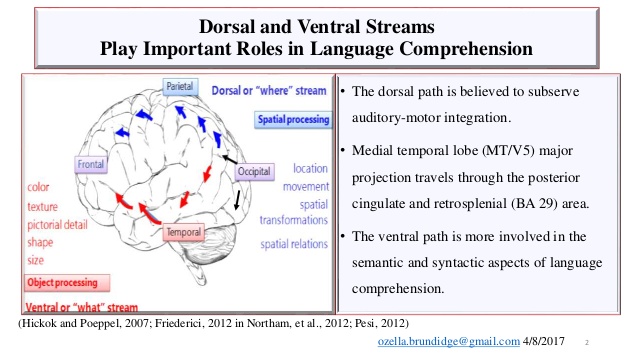
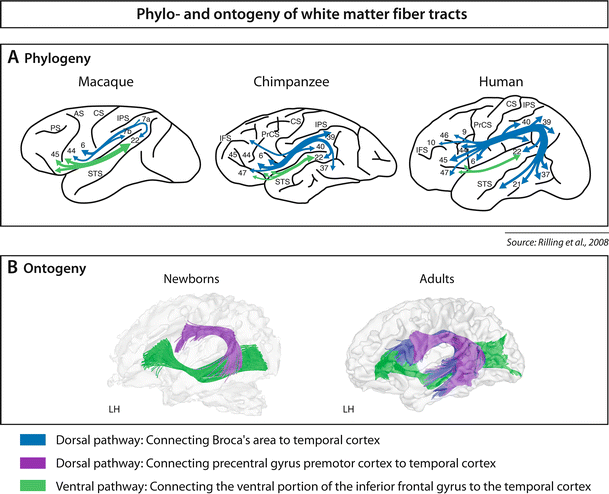
One of the main points, and for me the most interesting, is the idea that we each have specific "language brains." That is to say, our brain structures actually differ in systematic ways according to the language(s) we speak. For example, a German speaker will have a stronger than average dorsal fiber track, while an English speaker will have a stronger ventral fiber track (these tracks and their differences merit a separate post, but see images below for a quick view of some of their functions). And speakers of Chinese will have stronger connections between the two hemispheres of the brain. This could be indirect corroboration of at least a weak version of the Sapir-Whorf hypothesis.
From the Amazon summary:
A comprehensive account of the neurobiological basis of language, arguing that species-specific brain differences may be at the root of the human capacity for language.
Language makes us human. It is an intrinsic part of us, although we seldom think about it. Language is also an extremely complex entity with subcomponents responsible for its phonological, syntactic, and semantic aspects. In this landmark work, Angela Friederici offers a comprehensive account of these subcomponents and how they are integrated. Tracing the neurobiological basis of language across brain regions in humans and other primate species, she argues that species-specific brain differences may be at the root of the human capacity for language.
Friederici shows which brain regions support the different language processes and, more important, how these brain regions are connected structurally and functionally to make language processes that take place in milliseconds possible. She finds that one particular brain structure (a white matter dorsal tract), connecting syntax-relevant brain regions, is present only in the mature human brain and only weakly present in other primate brains. Is this the "missing link" that explains humans' capacity for language?
Friederici describes the basic language functions and their brain basis; the language networks connecting different language-related brain regions; the brain basis of language acquisition during early childhood and when learning a second language, proposing a neurocognitive model of the ontogeny of language; and the evolution of language and underlying neural constraints. She finds that it is the information exchange between the relevant brain regions, supported by the white matter tract, that is the crucial factor in both language development and evolution.
From The Brain Science Podcast summary:
Angela Friederici's new book Language in Our Brain: The Origins of a Uniquely Human Capacity captures decades of research. Although the book is quite technical, our recent conversation (BS 144) provides an excellent overview to listeners of all backgrounds. Our earliest knowledge was acquired from patients with brain lesions, but newer tools allow researchers to correlate concepts from Linguistics, such as phonology, syntax and semantics, with the neuroscientific tools such as EEG and imaging.
EEG evidence shows that phonology (sound) and syntax (grammar) are processed very quickly (by ~150ms) and automatically, while semantics (meaning) is processed a little later. The question of where each of this processes happens is challenging to answer because current imaging methods like fMRI provide excellent spatial resolution, but are much too slow to separate out these components. In her interview Dr. Friederici explains how experiments are designed to overcome this limitation.
There is also an increasing interest in the connections between the various brain areas that are involved in language. It appears that similiar areas (frontal and temporal) are used across languages but there a marked differences in the connecting pathways that reflect both what language a person speaks, but also other factors. For example, sign language is processed in the same areas as spoken language, but the pathways from the auditory cortex are less developed.
We also talk briefly about the developmental aspects of language and Language in Our Brain: The Origins of a Uniquely Human Capacity provides an extensive introduction to the current literature, including reflections on how the language aspects of the brain evolved.
Extracted text from http://brainsciencepodcast.com:
ReferenceError: Can't find variable: Audio
http://html5-player.libsyn.com/embed/episode/id/6528219/height/90/theme/custom/autoplay/no/autonext/no/thumbnail/yes/preload/no/no_addthis/no/direction/backward/render-playlist/no/custom-color/87A93A/?wmode=opaque:253 in global code BRAIN SCIENCE PODCAST Language in the Brain (BS 144) with Angela Friederici April 26, 2018
ANGELA FRIEDERICI (CLICK IMAGE TO PLAY AUDIO)
Angela Friedericis new book Language in Our Brain: The Origins of a Uniquely Human Capacity captures decades of research. Although the book is quite technical, our recent conversation (BS 144) provides an excellent overview to listeners of all backgrounds. Our earliest knowledge was acquired from patients with brain lesions, but newer tools allow researchers to correlate concepts from Linguistics, such as phonology, syntax and semantics, with the neuroscientific tools such as EEG and imaging.
EEG evidence shows that phonology (sound) and syntax (grammar) are processed very quickly (by ~150ms) and automatically, while semantics (meaning) is processed a little later. The question of where each of this processes happens is challenging to answer because current imaging methods like fMRI provide excellent spatial resolution, but are much too slow to separate out these components. In her interview Dr. Friederici explains how experiments are designed to overcome this limitation.
There is also an increasing interest in the connections between the various brain areas that are involved in language. It appears that similiar areas (frontal and temporal) are used across languages but there a marked differences in the connecting pathways that reflect both what language a person speaks, but also other factors. For example, sign language is processed in the same areas as spoken language, but the pathways from the auditory cortex are less developed.
We also talk briefly about the developmental aspects of language and Language in Our Brain: The Origins of a Uniquely Human Capacityprovides an extensive introduction to the current literature, including reflections on how the language aspects of the brain evolved. BS 144 Angela Friederici Ginger Campbell, MD
How to get this episode:
FREE:audio mp3 (click to stream, right click to download) Coming Soon: Episode Transcript [Buy for $2][Link for Premium subscribers] Premium Subscribers have unlimited access to ALL old episodes and transcripts, as well as extra content for selected episodes. New episodes of Brain Science are ALWAYS FREE. The most recent 50 episodes are also free. See the individual show notes for links to the audio files.
Links and References
Language in Our Brain: The Origins of a Uniquely Human Capacity by Angela D. Friederici Language at the Speed of Sight: How We Read, Why So Many Cant, and What Can Be Done About It by Mark Seidenberg (BS 136) Dr. Angela Friederici- Max Plank Institute for Cognitive Science in Leipzig Germany Announcements
Our new monthly Facebook Live session is scheduled for the first Thursday of the month at 8PM Central Time. Visit our Facebook Fan Page to learn more. I will be taking a group to Australia in late May 2019. More details will be announced next month. Please send feedback to brainsciencepodcast@gmail.com
Comment Books, Brain Imaging, Brain Research, Interviews, Linquistics, Neuroscience, Podcast Show Notes Angela Friederici, Language, Brain, Neuroscience
Share Go to top of page
BSP SHOW NOTES
SUBSCRIBE NOW
Go to top of page Copyright 2013 - 2016 Virginia Campbell, MD. All Rights Reserved.
Another website made with love by Sue Wallis Williams
ShareThis Copy and Paste POWERED BY SQUARESPACE
3 comments
Sign in to join the conversation.
Thanks. I assume that the book talks about bilingual brains somewhere. Any more summary?
My first thought was how culture affects brain development. In your example of German vs English, the cultural differences struck me most. Have there been any studies linking culture and brain development?
Janet, there are a couple of relevant posts here on MAP. You could start with this one: “Human learning and the child's developing brain.” (Patricia Kuhl) Humans are born with uniquely underdeveloped brains compared with other mammals, which means that brain development is still going in human infants while social-cultural reproduction (including language acquisition) has begun. Also, you could look on the web or on Amazon (expensive!) for cultural neuroscience and/or neuroanthropology. These two links looked promising (I have only scanned them so far) to start with: http://www.apa.org/monitor/2010/11/neuroscience.aspx https://www.ncbi.nlm.nih.gov/pmc/articles/PMC3409833/