

JCBT, Tov, and HOTTP
Below is what I wrote for my notes as the designated responder to Professor Tov at the UBS TTW in Merida in 1997. I was responding to his perspective (which he still holds to this day) that Hebrew Bible text criticism is essentially a subjective enterprise. I saw and see his point, but did not and do not entirely agree.
____________________________________________________
Symposium on Hebrew Bible Text Criticism-Merida, 1997
In spite of apparent and real subjectivity in textual criticism, it remains arguably the most principled discipline in all of biblical studies. If a group of scholars agree on their text-critical principles, as well as the relative weight and their order of application of these principles, there is a far better chance that they will agree with one another and themselves at the end of the day than in any other field of biblical studies.
Sacred story has become sacred text and now is becoming sacred story again in new media. For the Christian traditions, it never became stable sacred text to the degree that it did in the Jewish tradition(s). The cat was already out of the bag (genie out of the bottle) when the NT was written in Greek and quoted (to a large degree) the LXX. Its Jewish authors were obviously aware of something like the MT as well as of other traditions which show up in places like the Targums and other extra-biblical literature. Pandora’s box was thus opened not 200 years ago, but 2000.
The Jewish community has in one sense never translated its text. That community’s history has funneled pluriform textual and canonical traditions into a fairly narrow stream. Christians would have to have both Greek and Hebrew school to reproduce the same kind of coherence the Jewish community has achieved by this means.
____________________________________________________
As support for my claim above that Hebrew Bible text criticism can be a principled project, I submit the introduction(s) to the Hebrew Old Testament Text Project series put out by a team led by Dominique Barthélemy which set out both the general principles and the specific criteria for the decisions the team took. In the end, their conclusions are very often quite close to Professor Tov's, but for explicitly different reasons.
(Highly abbreviated forms of the ratings (principles) and factors (criteria) are integrated into Paratext's source language window-see examples below.)
Already in 1993 I had written a short review for TBT on Tov's Textual Criticism of the Hebrew Bible. I include it here:
------------------------------------------------------------------------------------------------------------------------
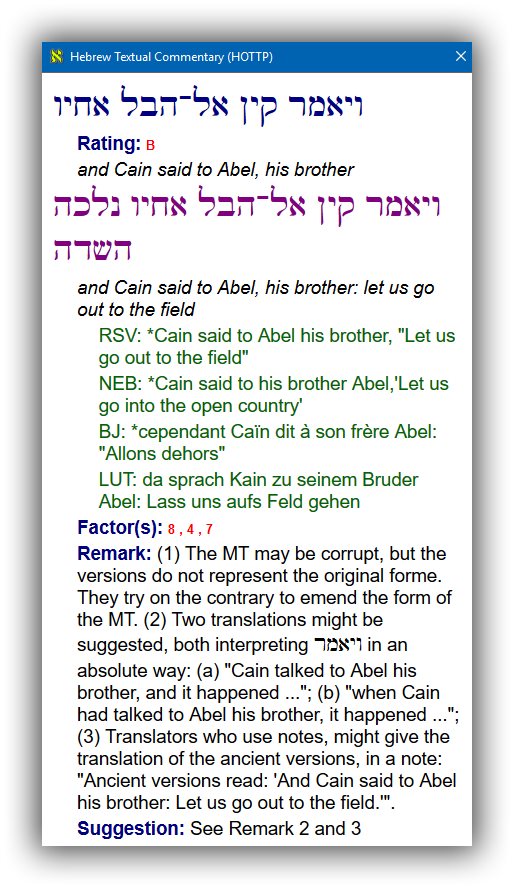
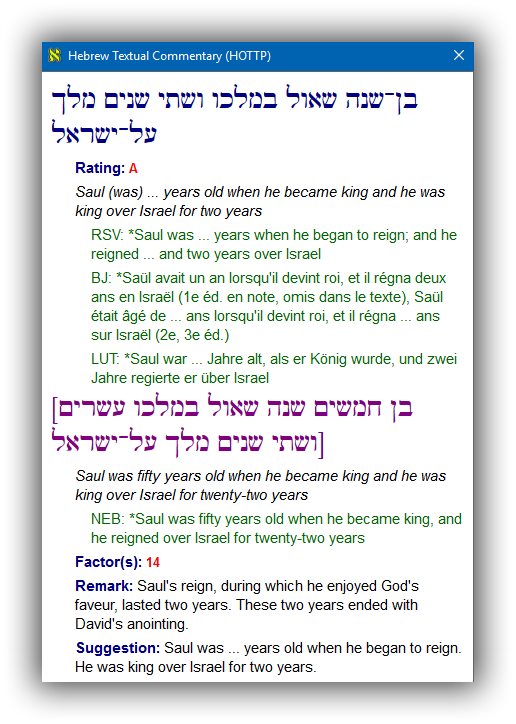
Finally, here are two examples of the HOTTP committee's decisions. Professor Tov listed these as well, and agrees with the committee's decision to follow the MT in both cases. Still, rabbinic logic and all, I prefer the approach which lists the criteria and principles by which one comes to a conclusion.
Genesis 4:8 (vayomer interpreted in an absolute way):
1 Samuel 13:1 The two years of Saul's reign were those before the anointing of David by Samuel. Note that the committee does not solve the first "son of a year" problem:
Extracted text from Basic_Principles_Employed_by_the_Committee-edited.pdf:
BASIC PRINCIPLES EMPLOYED BY THE HEBREW OLD TESTAMENT TEXT COMMITTEE
A - This form of the text has a very high probability of representing the text of the Second Phase B - This form of the text probably represents the text of the Second Phase, but there is some doubt C - This form of the text possibly represents the text of the Second Phase, but there is considerable doubt D - There is a possibility that this form of the text represents the text of the Second Phase, but this is highly uncertain
1/1
Extracted text from Factors_Involved_in_Textual_Decisions-edited.pdf:
9/28/2018
Factors Involved in Textual Decisions
FACTORS INVOLVED IN TEXTUAL DECISIONS If all the different forms of a particular text are carefully compared (without attempting to determine the literary or archeological factors which may have given rise to existing textual differences) it soon becomes evident that there are two distinct but complementary types of factors which are relevant for determining which form of the text is likely to have been original and which form or forms are secondary. The first type of factors may be regarded as essentially descriptive of the structural relations between the different forms of the text, and as such may serve to help evaluate the relative worth of the textual forms. The second type of factors may be viewed as causal in that they attempt to explain the reasons for certain alterations in the text. These factors may be called factors of modification.
A. Factors of evaluation Three factors of evaluation have been employed by the Committee:
- Narrow basis for a variant form of the text = Factor 1. If a form of the text occurs in only one tradition, for example, the Targum, Syriac, or Vulgate, one is less inclined to regard it as original than if it occurs in more than one such tradition. On the other hand, in treating textual evidence, one must not count text traditions, one must weigh them. That is to say, it is not the number of textual witnesses but the independence of their witness which is important. For example, sometimes the text of the Syriac version is important, but often this version simply follows the Septuagint or the Targum, and therefore in such instances it cannot be counted as an independent witness.
- Deceptive broad basis for a variant form of the text tradition = Factor 2. In certain instances a variant form of the text may appear to have a broad base, in that it is represented in a number of different textual traditions, but a closer examination of the situation may reveal that these traditions have all followed the same interpretive tendency. This frequently happens when an original text contains an obscurity which can be readily removed by what seemed to early scribes or translators as an obvious improvement. But instead of being independent witnesses to some earlier Hebrew form of the text, these alterations are all secondary and dependent, not upon the particular verbal form of some text, but upon a special way of interpreting the obscurity.
- Dependence of a variety of text forms upon one earlier form = Factor 3. When an original text contained a particularly difficult expression (either inherently difficult or rendered such through the loss of background knowledge necessary to understand its meaning), different scribes and translators often resolved the textual problem in quite diverse ways. Accordingly, one must look for a "key" to explain how the diverse forms may have arisen. Beginning with this one"key" form of the text one can often readily describe how the other forms developed, while beginning with any other form of the text would result in a hopelessly complex description of developments. These evaluative factors are complementary and may lead to opposite judgments in apparently similar situations. Hence they must always be supplemented by at least one or more of the causal factors (called "factors of modification") which have given rise to the changes in question.
B. Factors of modification If the actual textual situation is considered to be the result of a historical development which produced variant text forms under the influence of different causes, then the causes involved may be designated as "factors of modification". From this genetic perspective such factors are viewed as the reasons for textual alterations. Two kinds of modificational factors must be distinguished: (1) the conscious alterations made by scribes and translators (Factors 4-9) and (2) the unconscious or "mechanical" errors (Factors 10-13). The conscious alterations made by scribes and translators can be summed up under the following six headings listed primarily in the order of their importance and frequency:
- Simplification of the text (easier reading) = Factor 4. When a text was particularly difficult, there was a tendency for ancient scribes and translators to simplify the text by employing contextually more fitting lexical, grammatical, and stylistic forms (these modifications are often spoken of as "facilitating"). This is not the same as adjusting the form of the text to the translational requirements of the receptor language nor is it equivalent to introducing some preferred interpretation. It is only the amelioration of what seemed to be unnecessary difficulties. This tendency toward simplification means, however, that quite often the more difficult text may be regarded as the better, since one may readily explain why a complicated form is made simpler, but find it difficult to explain why a clear, simple text would have been purposely made more complex.
- Assimilation to parallel passages = Factor 5. Some variant forms of a text arose because ancient editors, scribes, or translators, assimilated the text of one passage to that of a similar or proximate passage, usually with the apparent purpose of attaining greater consistency. Some of the more common types of assimilation include assimilation to more explicit details given in a nearby passage, assimilation of described action to a previous account of plans or command for such action, assimilation to the form of a passage which has greater literary of theological importance, and assimilation to the recurring grammatical and lexical forms of a particular passage. There are also many instances in which repeated content, instead of being presented in a more concise form (as is so often the case), is reproduced with precisely the same wording which it has at the place of its first occurence. Whenever it seems clear that an assimilation has occurred, the unassimilated form is presumably earlier.
- Translational adjustments to the text = Factor 6. In order to produce satisfactory translations in ancient versions such as Greek, Syriac, and Latin, it was often necessary to make certain adjustments in the forms of the receptor language, since a literal word-for-word reproduction of the Hebrew text would have been unacceptable. Therefore, when there are differences between the renderings of the ancient versions and the traditional form of the Hebrew text, one must always try to ascertain (1) whether such differences can be explained on the basis of the linguistic requirements of these ancient receptor languages or on the basis of the stylistic peculiarities of ancient translators or (2) whether there was some different underlying Hebrew text which formed the basis for the versional tradition.
- Interpretive modifications = Factor 7. In some instances a particular form of the text may appear to be essentially interpretive. That is to say, certain ancient editors, scribes, or translators may have thought that the underlying text should be changed or amplified to conform to certain views, primarily theological. Or they
file:///C:/Users/basco_000/Dropbox%20(Personal)/~UBS/Workshops-Current/-English%20Workshops/7%20text-canon/HOTTP/HTC-FACTORS-EN.H
1/3
9/28/2018
Factors Involved in Textual Decisions
may have wished the text to state explicitly a meaning which was not completely clear. Such variant forms of the text which would have arisen in later phases of textual development cannot be regarded as valid alternatives. 5. Misunderstanding of linguistic data = Factor 8. Knowledge about certain features of biblical grammar and lexicography, including related practices of ancient copyists of manuscripts, were sometimes lost (in certain instances even by the time of the earliest attested text). As a result certain alterations were made in texts, because the meaning of these passages had become obscure. But evidence from (1) the Hebrew 'language in particular, (2) related Semitic languages in general, and (3) the language, style, and peculiarities of the ancient versions helps in many cases to recover the original meaning of a difficult text and thus to determine the original form of the text. 6. Misunderstanding of historical data = Factor 9. Over a period of time certain elements of the historical and cultural settings of the Old Testament which were understood and tacitly presupposed by the biblical authors as the normal conditions of their life and speech, disappeared or underwent important changes. Consequently many texts based on such patterns of behavior became unintelligible to later readers. Such misunderstandings of old texts led to textual alterations, which were designed to give a sense to passages that had become obscure. Newly recovered evidence concerning ancient biblical and Near East cultures and civilizations, their laws and customs, and cultic, military and political life assist scholars in recovering the meaning of obscure texts and thus distinguish earlier textual forms from the later modified forms. The unconscious alterations that brought about textual modifications in the course of text transmission may be summed up under four points:
- Accidental omission of similar letters, words, or sentences = Factor 10. When scribes copy manuscripts they may accidentally omit sequences. For example, if two phrases end with a similar sequence of letters, the second of the phrases may be accidentally dropped. (This is technically called homoeoteleuton.) Conversely, if two expressions begin with similar sequences of letters, scribes may also accidentally omit the first expression. (This is technically called homoeoarcton.) In some instances, two sequences may be entirely identical (sometimes in Hebrew the consonants may be identical, while the intended vowels, and hence the meaning, may be quite different), and the accidental omission of one of these by a scribe is not infrequent. (This is technically called haplography.)
- Accidental repetition of identical sequences = Factor 11. In contrast with accidental omission of expressions, there is also the relatively less frequent possibility of accidental repetition of the same sequence of letters. (This is technically called dittography.)
- Other scribal errors = Factor 12. There are many other scribal mistakes, such as confusion and transposition of letters, false separation of words and sentences (in many old writings there was no indication of word or sentence separation), and dropping out of letters; sometimes the consonantal scheme of a word was badly interpreted (since Semitic writings do not always note all the vowels in a word, there exist ambiguous words and phrases which can be interpreted in more than one way); sometimes there were mistakes based on confusingly similar sounds (when copyists wrote from dictation); and finally, there are other errors difficult to explain.
- Conflate readings and doublets = Factor 13. Another type of error is on the boundary line between the unconscious scribal errors and the intentional interventions of Factors 3 and 6. Difficult texts were sometimes accompanied in manuscripts by short explanations or alternative readings. Often they were put between the lines, over the difficult passage, or in the margins of the manuscript. Some copyists unfortunately did not carefully distinguish between the text and such glosses, but wove them together in the body of the text. This led to expanded text forms, as well as to doublets. Sometimes also a textual form underwent modification but the corresponding unmodified, original form was not deleted. An earlier form and a later modified form then existed side by side, and finally both became part of the text. The resulting text is called a conflate reading. All these factors of modification may be said to have a positive and a negative aspect. They explain both why a given textual form is the result of some later alteration arising during the history of the transmission of the text and why the opposite text form is the more original one. Thus all the causative factors, stated above in a negative way, that is as revealing the secondary character of certain textual forms, can be stated positively as indicating why features of the rival text form are original. For example, Factor 4 (Easier Reading) may be positively restated, namely, that the more difficult or harder reading is generally a sign of the more original text form. Similarly, Factor 5 (Assimilation) can be reformulated as : the distinctive, dissimilar form is more likely to be original than an assimilated form. Likewise, Factor 7 (Interpretive Modification) is equivalent to saying that a text which does not easily fit into an interpretive framework of a textual tradition has a stronger claim to authenticity than texts conforming to it. Since these factors are always used in this report to determine the rejected (secondary) readings, they are expressed here in the negative form. In listing the factors which were involved in the Committee's decisions no attempt is made to discuss the procedures of textual analysis nor the manner in which various combinations of evidence are evaluated. These matters will, of course, be discussed in the full scientific report.
C. Additional factors Two further elements may be added although they cannot be regarded as factors of the same kind as those mentioned above:
- Conjectural form of the text = Factor 14. When a form of the Hebrew text seems particularly awkward (either because of the grammatical forms or the unusual words involved), scholars have sometimes suggested an alternative expression which seems to fit the context better. Sometimes this involves only a change in the order of words, a shift in the order of letters, a different division of words and phrases, or simply modifications in vowel pointing. In other instances it may involve rather radical rearrangements and substitutions. But in view of the fact that the Committee was asked to analyze the textual rather than the literary problems of the Old Testament, it would be outside the terms of reference adopted by the Committee to propose suggestions which are purely conjectural, that is to say, those which are not reflected, either directly or indirectly, in some existing forms of the Old Testament text, whether in Hebrew or in the various ancient versions. In rejecting a particular conjecture, the Committee several times gave only a B or C rating to the preferred reading, but such a rating does not indicate any favorable attitude toward the conjecture. Rather, such a rating indicates only the intrinsic difficulties involved in the chosen reading, which cannot be said with certainty to be the original form of the text.
- Inexplicable texts = Factor 15. In certain cases the most satisfactory text which can be ascertained by the use of principles of textual analysis may nevertheless be quite inadequate, either because of some early scribal errors or simply because the background data necessary to understand fully the meaning of such a text no longer exists. In such instances it is necessary to recognize the unsatisfactory nature of the selected form of the text, but at the same time
file:///C:/Users/basco_000/Dropbox%20(Personal)/~UBS/Workshops-Current/-English%20Workshops/7%20text-canon/HOTTP/HTC-FACTORS-EN.H
2/3
9/28/2018
Factors Involved in Textual Decisions
to provide translators with advice as to how they can best treat the difficulties. In most cases they are advised to follow the lead of one or more of the ancient versions, despite the fact that such a versional solution is admittedly secondary. Factors 14 and 15 will sometimes occur in this report because modern translations make use of conjectures, and a few Old Testament passages seem to resist any truly satisfactory judgment about the original reading and its plausible explanation.
file:///C:/Users/basco_000/Dropbox%20(Personal)/~UBS/Workshops-Current/-English%20Workshops/7%20text-canon/HOTTP/HTC-FACTORS-EN.H
3/3
Extracted text from TOV.DOC:
Tov, Emanuel: Textual Criticism of the Hebrew Bible. Minneapolis: Fortress, 1992. xl + 456 pp. $40.00 ISBN 0-8006-2687-7 (Assen/Maastricht: Van Gorcum, ISBN 90-232-2712-3). This English translation/revision of the Hebrew version of this book (published in 1989), was greeted with great anticipation in the field of textual criticism. Those who waited eagerly have not been disappointed. There is much information in this book. In fact, it can be used as a ready-reference tool, it is so extensive and well organized. On the other hand, its style and presentation are accessible to the nonspecialist, and while not always easy to read due to its technical subject matter, it is clear and straightforward, at times even deceptively simple. Tov knows text criticism is complex and difficult, and frequently reminds his readers of this fact. This must not be forgotten if the book is to be understood well and used profitably. After some front matter and an introductory chapter, Tov deals with the textual witnesses of the Hebrew Bible in his second, the longest and most encyclopedic chapter in the book. It is a useful way to proceed, as so much of what is done in textual criticism depends on an understanding of what the witnesses are and what part they are presumed to have played in the history of the transmission of the text as a whole. Tov goes out of his way to stress that the MT is not to be found in any single Ms, but is a textual group or family which is evidenced in a number of Hebrew Mss as well as in other sources at times. The necessary changes having been made, the same principle holds for the LXX and the Old Greek, as well as the other versions. What is more, the MT is not the same thing as the Hebrew Bible which textual criticism seeks to reconstruct, but only a textual family witness (albeit the major one) alongside others which all must be evaluated in order to arrive at that goal. Tovs third chapter concerns the history of the Biblical text. Here others have traced a clearer picture (e.g. Talmon, Barthlemy), but perhaps one should not be overly critical of Tov at this point. He limits himself largely to a discussion of the original arguments of de Lagarde and Kahle in light of recent developments (mainly the discoveries at Qumran), and attempts it in less than fifty pages. It is here that the book is the most abstract and philosophical, and while one must in principle decide these questions (of Urtext vs. a pluriformity of textual types from a very early stage) a priori to a certain degree, Tov himself admits elsewhere (The Text-Critical Use of the Septuagint in Biblical Research, p. 35) that the two traditional positions are not as mutually exclusive as one might think. A helpful chapter (4) on the copying and transmitting of the Biblical text follows, followed in turn by two chapters on principles of evaluation of readings--one general, and one specific. It is the chapter (6) on the specific rules of evaluation of readings which will no doubt frustrate the greatest number of readers, specialists and non-specialists alike. Tov clearly states at various points that textual criticism cannot be rule-bound, but must instead be based on common sense. Here Tov must mean that there are so many variables in textual criticism, and they so often require various weightings, that simple-minded following of individual rules will produce a bad result as often (or more) as a good one. His argument is vulnerable in that any time a text-critical judgment is made, it must be defensible, and that defense will include some reference to a system or systems which others can agree on (or not, as the case may be). In the end, all scholars follow rules (or are accused of being idiosyncratic and arbitrary--in effect, non-scholarly), though these rules may be complex and weighed and applied in unexpected ways. The final three chapters (on literary criticism, conjectural emendation and critical editions), are all sober, informative, and in the mainstream of much of recent textual criticism. The book is a must for all those interested in the field. While one might find reason to fault it at points, at present it has no peer, and is not likely to have one for quite some time.
Robert A. Bascom
0 comments
Sign in to join the conversation.