

Patriotic Bibles
 Andy Warren-Rothlin · May 29, 2021, 12:29 PM · Last modified: Sep 28, 2026, 11:39 AM
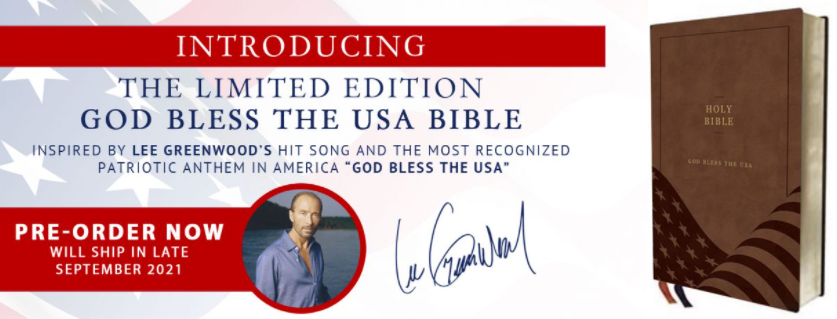
The various kinds of 'customised Bibles' (e.g. products for special occasions, particular denominations etc.) include nationally branded and marketed editions, such as those with a flag and some history (as in this example from Nigeria) and others which may be more subtle (will the German BasisBibel's red edition boom in Switzerland and/or flop near the German border with Denmark?!). The global Christian press is now talking about the 'God bless the USA Bible' (containing the US constitution etc. along with the KJV). In Germany it's reported that Zondervan have now decided not to publish it, one Australian outlet is referring to it as 'The Bible we don't need', and in the US Christianity Today write:
Joining God’s Word and the founding political documents of a single nation together in one volume signals a divine endorsement of what we have no evidence of God endorsing.
Most of us users of MAP are 'technical staff' - specialists in the Bible and its translation - often with a particular interest in ethical principles and values (and hence probably - whatever our nationality - horrified by the above, which I've at least tried to mitigate a little by citing non-US examples too). But most of us have little involvement in publishing, production and distribution issues (at least in Christian-majority contexts). We may complain that marketing pragmatism (sales) often seems to trump academic principles, but have we spoken up enough?
What do we actually think? Can we articulate why these things are bad? What are acceptable limits for such products? Can we as a community formulate recommendations that we would like to put to publishers?
Attachments
- Bible.png360 KB
5 comments
Sign in to join the conversation.
If we celebrate remote people groups culturally appropriating the Scriptures in their context with their fanfare, songs, traditional garb, emblems, etc., why should we be dismayed at examples like this of large people groups doing so? If having the Bible packaged this way becomes part of what attracts someone to God's word, I approve it. The important thing is that the translation itself has been done without heresy or undue theological bias. The US Constitution is not incompatible with the Bible.
Could we call this a political idiom translation? 😏 No, at least the text is the King James Version. So, it's more a matter of marketing than translation, as I see it. I wouldn't promote such a venture because I agree that our time is better spent equiping the global church with the Word in translation.
Andy, you are right to be concerned about the kind of syncretism that mixes nationalism with God's Word. However, I must admit I am surprised to hear you voice concern about this. Elsewhere you have supported a functionalist approach to Bible translation that supports "what the church wants." You have also elsewhere stated that we should be careful not to "fall into the trap of setting rules and fixed boundaries," yet here you ask what are "acceptable limits." From a functionalist viewpoint, if the local church in, say, West Virginia supports an American patriotic Bible, who are you as an outsider to say it's wrong?
The answer, of course, is that the Bible itself tells us that the Lord is Lord over all nations, King of Kings and ruler of all, that our citizenship is in heaven, and that in Christ there is "no Gentile or Jew, circumcised or uncircumcised, barbarian, Scythian, slave or free, but Christ is all, and is in all." It is the beautiful truth of God's Word that tells us that if the church wants such a thing, the church is wrong and should be gently and lovingly opposed.
The same approach can and should be used to reject the inclusion of the Islamic profession of faith (La ilaha illallah) in Bible translations, which you have approved of and have signed off on in your consulting work. Contrary to the functionalist paradigm that you espouse, the inclusion of La ilaha illallah in the Bible should be rejected even if some local believers support its inclusion (while many others oppose it), because its Islamic connotations are opposed to biblical truth about the Trinity and the nature of God.
In other words, your own discomfort about nationalistic Bibles including extrabiblical text such as the American Constitution is the Holy Spirit telling you this is wrong, and that therefore the functionalist paradigm you have bought into and supported is also wrong. Indeed, we do benefit from "rules and fixed boundaries" to keep translators and Bible marketers faithful (not that rules alone will ensure faithfulness), and sometimes what the church wants is not what God wants.
Are you willing to accept and concede this? Or is your functionalism a "functionalism for me, but not for thee" type? A functionalism for groups you like, and syncretism with thought systems you like, but not ones you dislike such as American nationalism? On what grounds is it acceptable to import Islamic slogans and symbols into the Bible, but reject American nationalist slogans and symbols? I hope this example helps you to see that it is better instead to let God's Word guide our decisions and reject all such distortions of God's Word, and not foolishly assume that whatever "the church" (however defined) wants is what God wants.
It's worth noting that the American Bible Society released the Freedom and Liberty Bible on April 23rd of this year.
https://news.americanbible.org/blog/entry/corporate-blog/introducing-the-faith-and-liberty-bible
Those interested in this thread may also be interested in this recent book:
"This study explores the role that Bibles have come to play in the worldview of the contemporary European far right. Taking the case of far-right terrorism in Norway on 22 July 2011 as a starting point, Hannah M. Strømmen argues that particular perceptions of “the Bible” and particular uses of biblical texts have been significant in staking claims to European identity in opposition to Islam. Such perceptions and uses are not only to be found in the case of far-right extremism. The Bible-use that this study maps operates more broadly in counter-jihadist writings, transnational right-wing movements, and conservative philosophy. Crucially, connections and continuities with past Bible-use are brought to light.Strømmen charts new directions for research in biblical studies, presenting a proposal for mapping how Bibles operate in the world as assemblages. Mapping biblical assemblages allows scholars of biblical reception to analyse diverse forms of Bible-use. Such mapping goes beyond the notion of the Bible as text to be read in order to address questions of agency, affect, and materiality. Ultimately, Strømmen proposes new ways to understand political Bible-use today in order to respond to violence inspired by biblical texts."