

EnglishGeneral
Biblical Translation as Invasion in Postcolonial Northern Ghana
NENathan Esala · Jan 9, 2025, 3:32 PM · Last modified: Sep 28, 2026, 11:39 AM
♡ 0
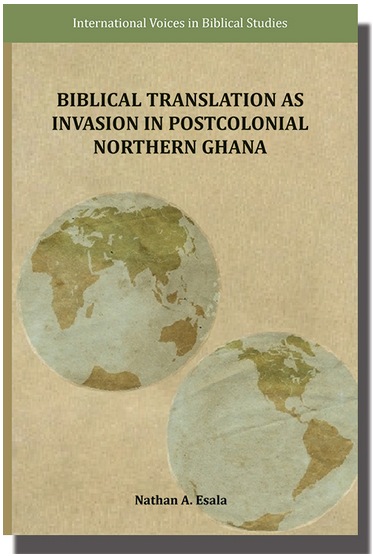
The first three chapters explore entangled indigenous/precolonial translation practices, followed by entangled invasive colonial political and religious translation practices. The last three chapters offer an alternative to invasive biblical translation practices by presenting case studies that adapt group Bible study for the purpose of collaborative and emancipatory retranslation. From people living with disabilities engaged in retranslating Job 2–3, to young women retranslating Ruth as they navigate sugar daddy systems, to communities in ethnic conflict retranslating Judges 6–9, this collaborative and dialogical approach to retranslating biblical tradition has the potential to build community in the face of oppression.
Attachments
- book_cover.png324 KB
7 comments
Sign in to join the conversation.
Hi Nathan, I have started my way through your book. So far, in chapter 1, I am very impressed! I have also come up with a question. What impresses me, is your effort to elucidate what happens to translation, let's say, as it is translated. Ghanaians have a variety of different understandings of the term translation itself, such as that it is a process of turning language rather than an ends-oriented effort. I am now looking at Kopytoff.My query, although still early in the book is, how this will be helpful? Perhaps you will tell us later in the book?? What you are doing, it seems to me, in a way, is to assist a (native) English speaker to 'think that' he or she can 'grasp' something about northern tribes of Ghana’s ways of life, without having to learn their language. Now, I agree that they can grasp something about the process of grasping such language(s). The drawback is, that this can seem to make actual (in-context) learning of the language less important. I also wonder what is the value of the native-English speaking reader who can get to think that they can grasp what is going on. As you unpack translation processes, yet continue to use English, the question is, does the reader as they progress transform their comprehension of terms you use? Even should they do so, will they carry them forward to the reading of their next book? Unfortunately, it seems to me, should they do so, they will misunderstand, or fail to understand, the 'next book', the correct understanding of which assumes someone to be ignorant of what you are enlightening us about. So then, what value in what you are telling us?In other words, your enlightening us as to the nature of translation in a Ghanaian language(s) while a titillating exercise for boffs like us, may be making us blasé, or the less oriented to actually become holistically informed, that requires learning of the language in context. Thus are you by undermining the indigenous language, cutting off Ghanaians from informed communication with the wider world, while yet for them to express themselves requires them to use their language?I may have more questions as I go on!
Hi Nathan, I have read almost all of your book. Congratulations on a very thoroughly-researched piece, that looks at a Northern Ghanaian context in intricate detail, revolving around the theme of translation, and Bible translation. (Translation as 'turning', the same applies to the Luo language of Kenya!) I have thought about writing a review. I would probably only want to do so if you give me 'editorial support'. In other words: I haven't read every word, and I mostly 'listened' to your book while sitting in a bus, so didn't take notes, and I wouldn't want to take a review onto a tangent that you wouldn't approve of. Let me know.
Hi Jim, Just getting to this response. Your critique in the above post is penetrating. I hear you saying that my writing in English about the conceptual realities of translation in northern Ghana has been of very little pragmatic value. I am tempted to say that you have not perceived my argument. But I don't want to sell your critique short. Here's another try...
Like you, I have found language and culture immersion to be transformational. I describe my 10 years living in northern Ghana as where I learned to "become a human being." Nevertheless, it is the Western cultural aspects of my own assumptions about language and cultural boundaries that were not easily "transformed" simply by learning to speak the language. Perhaps a better illustration of this is the colonial notion of "tribe" and how the colonial notion of tribe has partially translated itself into the northern Ghanaian consciousness. The enforcement of"customary" courts has partially changed the way people understand "tribe.” People still think in their own languages, but colonial interventions have altered (partially) the way people understand the word that I use the English word "tribe" to signify. I am leaning on Ngũgĩ wa Thiongʼo’s Decolonsing of the mind which he wrote in English, but I also recognize that later on, wa Thiong’o chose to write novels in his own language (Kikuyu?) and force people to translate his novels into English.
Perhaps what I have done is translate into English my own experiences. If I were writing or speaking in Likɔɔnl, I would describe this argument differently Probably the same would be true if I was using “Ghanaian spoken English” to make this argument rather than "American written English." I take your encouragment that it would be good for me to try and do this. In order to force the academic world to engage in the way wa Thiongʼo suggests, I should have written (or spoken!) my book in Likɔɔnl and a Ghanaian colleague who speaks excellent English should have translated it back into academic English. That would have been a real challenge! Even though something like that would not work well without some serious funding help, it might be fun to try it on a small scale--similar to the way the Akrofi Christaller Institute in Ghana requires their students to write a summary of their argument in the local language!
Hi Nathan, Thanks for coming back to me on this! I will have a look at writing a review. If I’m defeated, it may be because a few weeks have passed since ‘hearing’ it. I hope you are encouraged through your book getting attention!! I am impressed by your thoroughness. It would have been interesting, and rather unique, for you to have written your book in Likɔɔnl. Pragmatically speaking, I wonder whether you could have done that? I of course have to compare with my own experience, of knowledge of and use of the Luo language of Kenya. I could probably write a lot in Luo. I don’t think I’d easily get anyone to read what I write, which is one reason I don’t do it. A mismatch would be, that I would quickly drift into writing Luo as-if it is English. That is, in terms of pragmatics. When I say ‘pragmatics’, I mean the relationship between a language and its context of use. Luo is ‘designed’ to work within a context of use that is … well, Luo. I live much on the ‘edge’ of that context, but I cannot get into it in depth; it is just too ‘far away’. I wonder on your Ghanaian scholar who would translate your Likɔɔnl into English for you. I would have thought that would require an American / Western scholar? That is – it is always best to translate or one’s own people, whom one knows at depth. This on the basis that it is ‘more important’ to get terms to properly ‘fit’ into a target language, than it is to properly understand them in the source language. ( https://www.youtube.com/watch?v=qM2ui3m2P2M if you are interested!) The critique you here address, which I wrote while still early in the book, is I suppose of ways in which our academic productions send a message that says ‘you can understand without learning the language’, simply on the basis that we articulate what we do using English, articulations which we consider in some way to be ‘correct’. So this in a sense is ‘no point in your going to Ghana, you can read my book instead’ – which I suspect is not actually the message you want to give! Anyway, up to you whether you want to continue this discussion! Jim
Here's my proposed review. Feel free to review it if you think it doesn't do your work justice. It's short ... but hopefully may be of help to yourself and a few others.
Review of: Esala, Nathan A, 2024. Biblical Translation as Invasion in Post-colonial Northern Ghana. Atlanta: SBL Press.
Nathan draws on ten years of intimate connection with having lived in northern Ghana to write a detailed account of issues connected to Bible translation. His particular interest is in exploring the connection between Bible translation and neo-colonialism. The book is part of a series of International Voices in Biblical Studies.
The book consists of six sections, as follows:
1. Reconstructing Precolonial Translating Practices in Northern Ghana ...
2. Colonial Translation of/as Invasion
3. Entangled Ghanaian Christianities and Postcolonial Translation
4. Translating and Retranslating Bodies in Postcolonial Northern Ghana.
5. We are (Re)translating Wo/men.
6. Retranslating for Transsectoral Resistance
The term translation in English itself tends to be understood by Ghanaians as ‘turning’, Nathan tells us. This fact sets the tone for the book, a critique of simple traditional justification for Bible translation as provision of Christian Scriptures for the use of an African tribe. Nathan’s prescribed aid towards the facilitation of helpful Biblical understanding in Ghana, is Contextual Bible Study (CBS). CBS sessions are pivotal to Nathan’s learning experiences.
This well-researched book touches on many areas of concern entangled with Bible translation, to use Nathan’s phrase. The Bible can itself be an exploitative text, and can subordinate its readers, Nathan tells us, but local people rework that, at times to use the Bible in more contextually appropriate ways, even as a tool of divination. Bible translation needs to be seen in the light of other historical events, such as of renown in this part of Africa, the historical slave trade. Missionary-colonial legacies have not always been reputable, Nathan tells us. An outcome of this, is some shame by the West over the history of its interventions in Ghana, and in Africa beyond. Postcolonial translators are needed, who pay attention to emancipatory reinterpretations, as a way of reworking previously exploitative pathways.
The hard work that has gone into producing this text makes for an interesting and insightful read. It provides much historical data specific to its northern Ghanaian context, as well as insights with much wider application. If there is a valid criticism of the book, then for this reviewer, it is a lack of attention to underlying theory. The author launches into descriptions, and draws conclusions through making arguments, that remain very vulnerable to being undermined, were alternative theoretical pathways to be followed. What Nathan provides, is a deeply heartfelt account arising from life-changing experiences, that projects diverse insights, ramifications, and challenges arising from Bible translation in practice in contemporary Africa, considered contextually.
Jim, I appreciate the review. It does a succinct job of describing the book. Thank you.
In terms of your conclusion about "lack of attention to underlying theory," on one hand, I feel defensive. On the other hand, I like what you said about my interpretations being "vulnerable." I was intentionally vulnerable by paying close attention to the theories I employed. See p. 14-23 in chapter one where I discuss all the theoretical tools that I draw upon, explaining why I selected those theories in service to the northern Ghanaian context. As I explain there, I tried to make my theoretical lenses or glasses obvious so that readers can easily detect the theories I am using and rework them using other theories. In this way I was intentionally making my interpretation "vulnerable" [vulnerable mission!]. In other words, I am open to interpreters using other theoretical tools. All I ask is that other people try to make the tools they are using explicit in their interpretations. (Most scholars are not "vulnerable" in this way. They do not show their cards.) See 312-313 comparing European and African biblical scholarship.
The same goes for biblical interpretation sections in chapter 4-6. Note my use of tripolar hermeneutics on p. 176-177. Tripolar hermeneutics argues that interpreters should be "open" about their ideological and theological orientations and how those ideotheological orientations influence biblical interpretation/translation. See also footnotes 98-100 in that section.
So I am defensive of my attention to theory. But appreciate that you perceived this makes my readings/interpretations vulnerable. Deliberately so.
I just saw this thread, Nathan, and am eager to read your work. I have enjoyed your insights from previous BT Conferences and look forward to processing how you've put everything together. It's so encouraging to see more scholarship being brought to Bible translation in (post)colonial spaces from within the BT movement. If you plan to be in Chiang Mai for BT 2025 I'd love to compare notes with you about my own research in the Indigenous North American context.