

Journal of Translation 19.1 (2023) now available
The latest issue of SIL’s Journal of Translation is now available. Visit the links below to download PDFs of all articles free of charge.
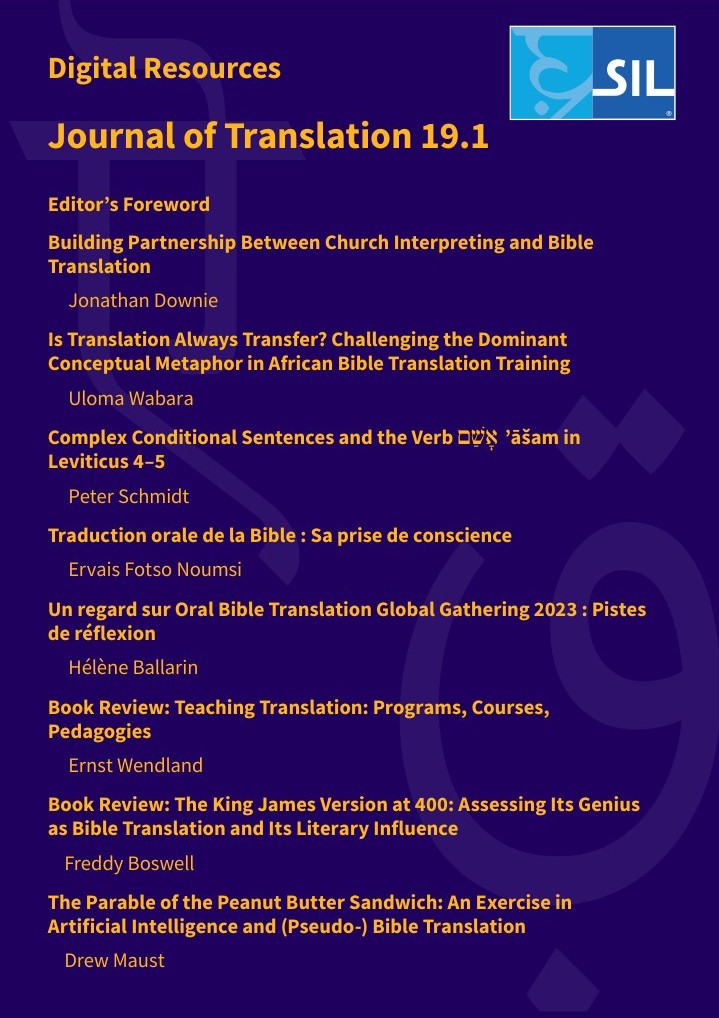
Journal of Translation 19.1 (2023)
- Downie, Jonathan. “Building Partnership Between Church Interpreting and Bible Translation.” 1–22. https://doi.org/10.54395/JOT-JN2VC.
- Wabara, Uloma. “Is Translation Always Transfer? Challenging the Dominant Conceptual Metaphor in African Bible Translation Training.” 23–39. https://doi.org/10.54395/JOT-K395D.
- Schmidt, Peter. “Complex Conditional Sentences and the Verb אָשַׁם ʼāšam in Leviticus 4–5.” 41–85. https://doi.org/10.54395/JOT-PXWN3.
- Fotso Noumsi, Ervais. “Traduction orale de la Bible : Sa prise de conscience.” 87–110. https://doi.org/10.54395/JOT-H8RGT.
- Ballarin, Hélène. “Un regard sur Oral Bible Translation Global Gathering 2023 : Pistes de réflexion.” 111–16. https://doi.org/10.54395/JOT-O4B6T.
- Wendland, Ernst. “Review of: Teaching Translation: Programs, Courses, Pedagogies, Ed. Lawrence Venuti.” 117–21. https://doi.org/10.54395/JOT-XA6HP.
- Boswell, Freddy. “Review of: The King James Version at 400: Assessing Its Genius as Bible Translation and Its Literary Influence, Eds. David G. Burke, John F. Kutsko, Philip H. Towner.” 123–26. https://doi.org/10.54395/JOT-JNPRM.
- Maust, Drew. “The Parable of the Peanut Butter Sandwich: An Exercise in Artificial Intelligence and (Pseudo-) Bible Translation.” 127–48. https://doi.org/10.54395/JOT-PBMIR.
Editor's Foreword
This issue of Journal of Translation is breaking new ground. In the 19 years of the Journal, this is the first time we have published an article in a language other than English. And we are doing this, not once but twice! Both are in French, and both complement one another on the subject of orality and Bible translation. One is by Cameroonian researcher and translation consultant Ervais Fotso Noumsi, and the other by French orality specialist Hélène Ballarin who provides a detailed report on the recent global orality conference and avenues of further reflection.
We also feature an article by African scholar Uloma Wabara on the concept of translation-as-transfer. I am confident that this will become a useful publication for future translation workshops.
We are publishing Peter Schmidt’s treatment of Hebrew conditionals, based on his research in Leviticus. Although our previous issue (JOT 18.2) was a thematic issue on conditionals, it did not include any contributions on conditionals in Biblical Hebrew. Schmidt’s article not only addresses that gap but will undoubtedly serve to stimulate subsequent study in the field.
Jonathan Downie publishes in the field of interpretation studies, and we are grateful for his contribution to this issue of JOT. He has presented an excellent approach on the interchange between the various strains of oral interpretation, with its more-or-less simultaneous or contemporaneous approach, and the detailed, reflective approach found normatively in both written and oral translation.
The remainder of this issue we present to you as something that would appropriately be termed in some journals as Divers. In this section, we are publishing two book reviews, and one article that is not peer-reviewed, but which is more of a translation conversation starter and prompt to generate future academic research. In addition to peer-reviewed articles, we invite you to submit to such sections in future issues of JOT.
Like me, you may not have been familiar with the volume by Lawrence Venuti on translation pedagogy which Ernst Wendland brings to our attention. Well worth acquiring and reading! I have reviewed a multi-author volume published by the Society of Biblical Literature covering the wide expanse of scholarship related to the 400th anniversary of the King James Bible.
I predicted in this space in the previous issue that Rachel and Michael Aubrey’s bibliography on conditionals would be well-received and frequently consulted. Our web traffic confirms as much: month-on-month the Aubreys’ bibliography continues to rank among JOT’s most read articles since its release. I will now make another prediction, related to this issue: Assistant Editor Drew Maust has entered the burgeoning field of artificial intelligence and Bible translation with “The Parable of the Peanut Butter Sandwich: An Exercise in Artificial Intelligence and (Pseudo-) Bible Translation.” This somewhat fanciful article should provoke scholarship and research at the intersection of these two fields. I can think of a long list of people who, through publishing, advanced ideas in translation and linguistics and thus stimulated further research by others. Gutt’s work on Relevance Theory is just one that comes to mind. What are the merits of Maust’s approach? You will be intrigued, as I was! My prediction is that this will be read and discussed widely for some time, being referred to as the field develops. Finally, I announce our desire to offer a theme issue on AI and Translation in the near future. Perhaps his article will be a catalyst to that end.
Enjoy! As always, we welcome your comments at editor_jot@sil.org.
Freddy Boswell, editor
About the Journal of Translation
Published by SIL International, the Journal of Translation is an open access, peer-reviewed academic journal of translation theory and practice with a special interest in sacred text translation and local languages and cultures. For more information, please visit https://siljot.org.
__
Journal of Translation
Freddy Boswell, series editor
Drew Maust, assistant editor
✉ editor_jot@sil.org
🌐siljot.org
@jotranslation
Attachments
- siljot2023_1-cover.jpg145 KB
0 comments
Sign in to join the conversation.